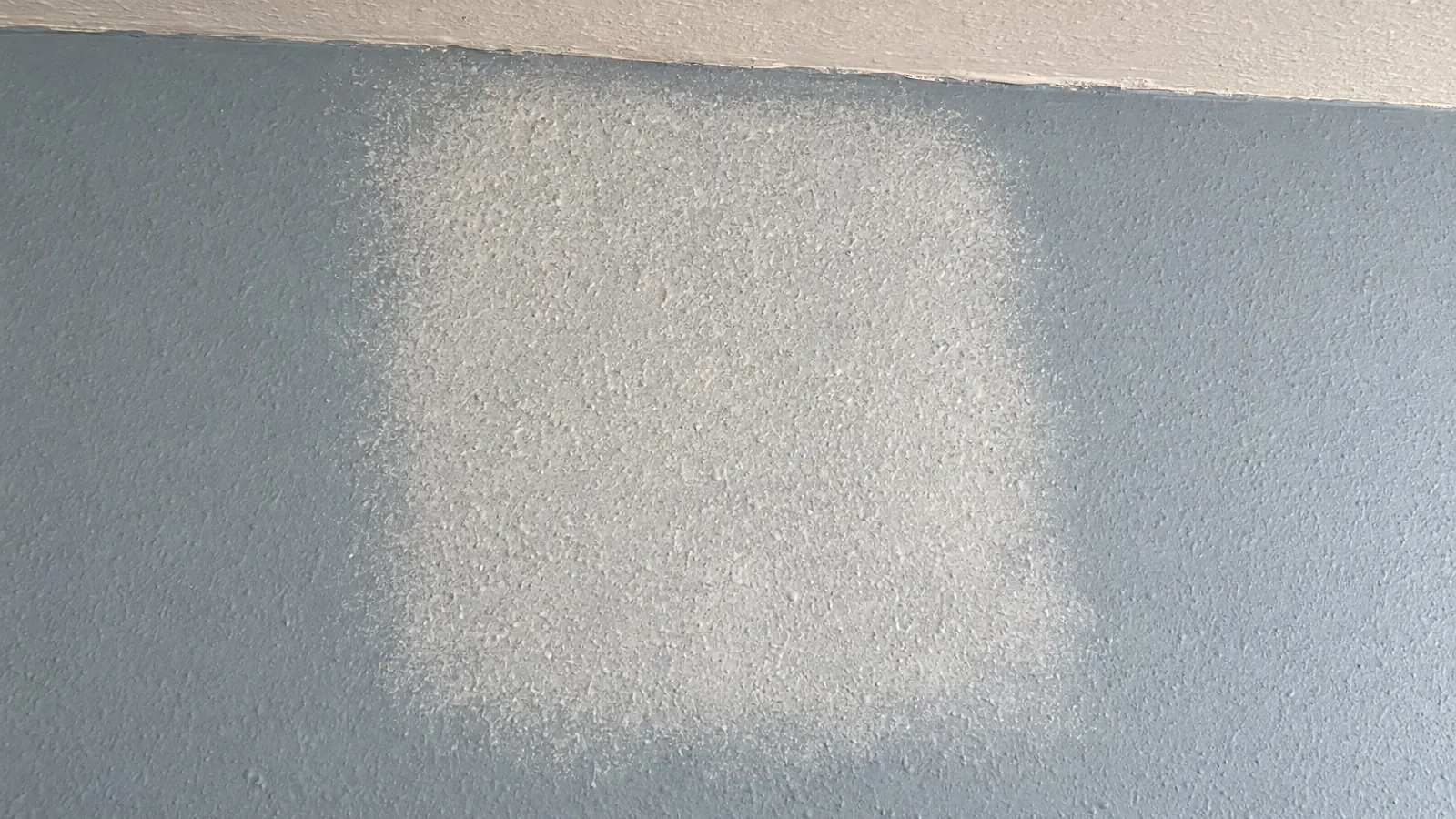
Drywall Repair in Camilla, GA
Water-stained ceilings, AC drain spills, settling cracks, loose plaster and punched-through holes, traced to their source and repaired with texture worked to blend into the wall around them.
Explain the mark you are seeing; a nearby drywall pro then follows through with a written figure.
Call 7 days, 7am–9pm
Spot the damage that matches yours
A call usually opens with a symptom, not a diagnosis. Below are four symptoms typical of houses built the way Camilla's were, each pointing toward its own repair route.
Tan halo beneath the attic air handler
A tan halo spreads across the hallway ceiling below the attic unit, sometimes soft at its center. Cooling equipment wrings a surprising amount of moisture from humid summer air. If algae plugs the condensate pipe or the drip tray corrodes through, that water drops onto gypsum instead of leaving the house. Fixing the drain comes first. After it flows again, soggy board gets trimmed out to where it is firm and dry, fresh board is screwed overhead into the joists, and the joints are taped, retextured and coated with a primer made for locking in stains.
Slanted line rising from a doorway's upper corner
A fine line rises on a slant from where the head of a door or window opening meets the wall. Openings gather the framing's movement, so that line tends to record the house shifting slightly as the soil under it wets and dries. A sound fix widens the line just enough for compound to bite, bridges it with tape set into compound, and spreads the coats wide, giving the next slight shift room without tearing open that same seam.
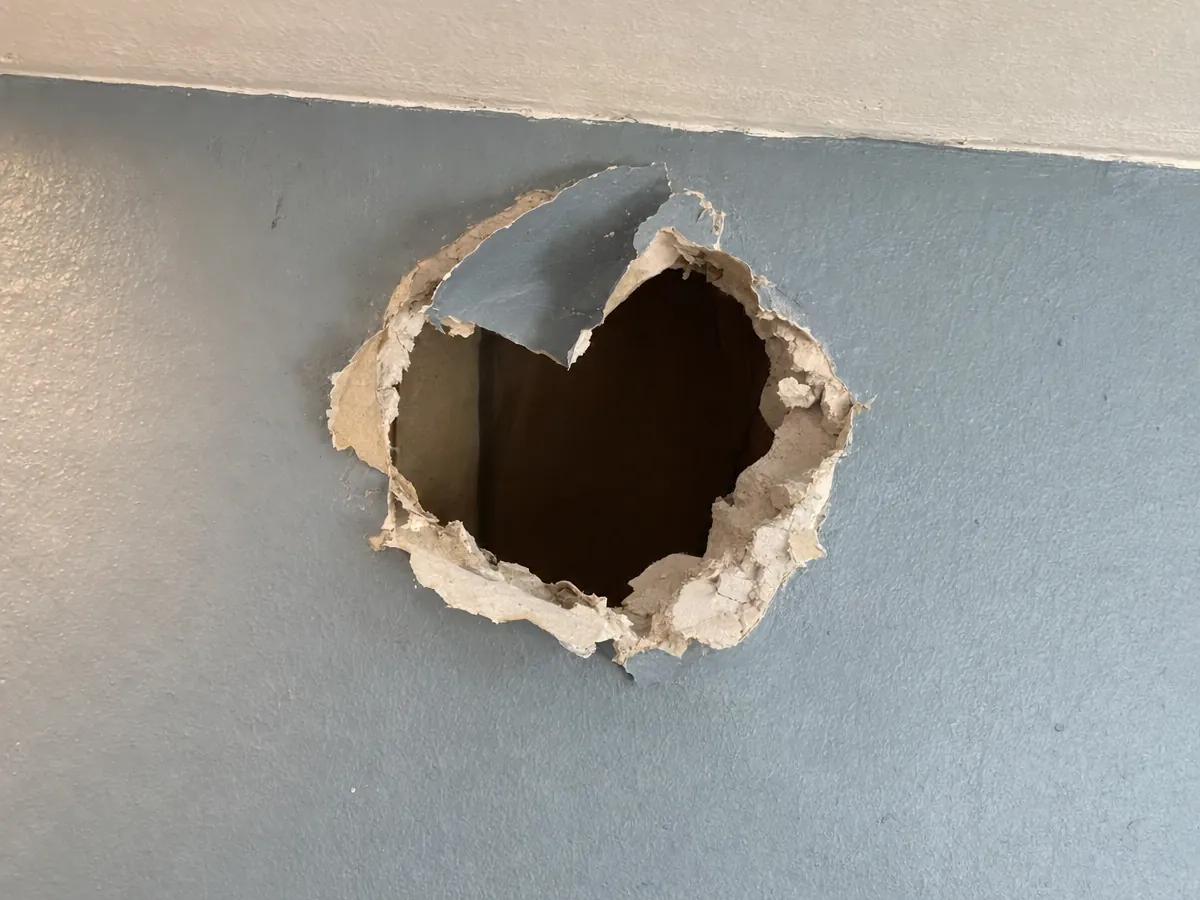
Round gap left by a slammed doorknob
Someone threw a door open and its knob broke straight through the face paper, crushing gypsum behind. The torn outline gets squared off, a backing strip or snug replacement square goes behind, and three thin coats bring everything level before the surface pattern is reproduced. A rubber bumper fitted low on the wall prevents an encore.
Drummy, bowed plaster in a front parlor
In an older house, part of the plaster wall gives a drummy note under a knuckle and may bow outward or show fine webbed cracking. That note says the plaster has let go of the strips of lath behind it. Often it can be drawn tight again using broad plaster washers ahead of crack filling, saving far more original wall than demolition would.
Trace one repair start to finish
- 1
Phone it in, or text a snapshot
Describe which room, roughly what size, and whether the area feels damp now. A snapshot that includes a ruler or quarter makes the scale obvious.
- 2
Talk it through
Next, a pro calls with questions about cause and extent, so the price reflects the real job.
- 3
Approve a figure
A price comes first. No board gets opened and no material gets bought until that figure has your yes.
- 4
Repair in layers
Damage gets trimmed out or prepped, then filled and built up across several thin passes. Compound must cure between passes, so even modest damage can need two short sessions.
- 5
Texture and prime
The finished area receives a surface pattern resembling its surroundings plus a coat of primer, leaving it set for your own paint or for painting arranged within that quote.
Pick the page that names your damage
Every repair here has a dedicated page covering typical causes, what doing it properly takes and what to watch later. Damage outside all five can still go in the form; it gets sorted out over the phone.
- Ceiling leak repairCeiling board browned, softened or sagging once a roof or pipe has let water in.
- AC drain water damageBoard soaked by an air handler's blocked condensate pipe or a corroded drip tray.
- Settling cracksSlanted lines off openings, split seams and gaps opening along the ceiling edge.
- Plaster patchingHollow-sounding, bulging or webbed plaster over old wood lath.
- Holes, dents and cornersKnob strikes, dings, popped fasteners and crushed outside corners, retextured.
Measure the damage against three sizes
Size changes how many passes go on, how long curing takes and how far texture must spread. To put it in proportion, Fixr, in its national drywall cost guide last revised January 2025, gives countrywide ranges for each kind of repair.
-
Small
What it covers: Popped fasteners, screw holes, shallow dings and hairline lines shorter than a foot.
What the work involves: A pass or two of compound, light sanding, primer on the spot, and a little texture over a tight area. Cure time is most of the wait.
Fixr's national figures put a hole repair at $60 to $200 and a nail pop at $75 to $140.
-
Medium
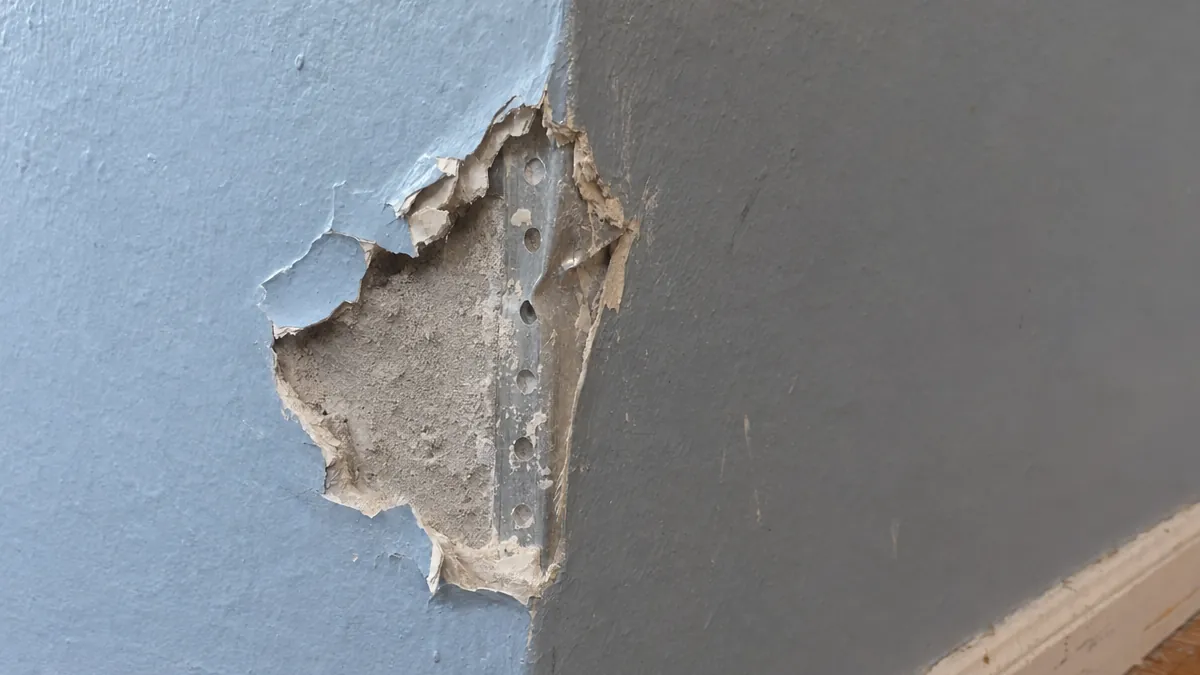
What it covers: Knob holes, several feet of opened seam, a crushed outside corner, or a crack returning again and again.
What the work involves: Backing or a replacement square of board, tape, three passes with curing between them, and texture feathered well beyond the edges so it fades out gradually.
Fixr's national figures put crack repair at $60 to $330 and a corner crack at $220 to $315.
-
Large
What it covers: Soaked ceiling sections, drooping board, or anything calling for whole or half sheets.
What the work involves: Wet material stripped out down to bare framing, new board fastened, full taping, texture spread wide, stain-locking primer, and frequently a return trip after compound has cured.
Fixr's national figures put water damage on walls or ceilings at $400 to $800.
Those are countrywide numbers from one published source, not what Camilla jobs cost. Locally, a quote shifts with plainer things: ladder height, smooth versus orange peel versus knockdown, whether the leak has been stopped yet, how many cure trips are needed, and whether painting belongs in the job.
See which towns are covered
Every repair booked here is based out of Camilla, seat of Mitchell County. The towns listed alongside are covered too; the area page gives each its own paragraph.
- Pelham. Eight miles southeast of Camilla along US 19, toward Thomas County.
- Meigs. A little past Pelham; mostly Thomas County, with a sliver reaching into Mitchell.
- Baconton. Up US 19 ten miles, roughly midway to Albany.
- Sale City. A small town twelve miles east of Camilla.
- Doerun. Over the line in Colquitt County, east-northeast of Camilla.
- Albany. Dougherty County's seat, 27 miles up US 19.
Compare patch, section and skim coat
| Criterion | Spot patch | Cut out a section | Skim coat the surface |
|---|---|---|---|
| Fits | Holes, dings, short cracks | Wet, soft or drooping board | Walls covered in small flaws, or tired plaster |
| Size of work | Roughly a square foot or less | Several square feet up to full sheets | One entire wall or ceiling plane |
| Passes and cure time | Two or three thin coats | Tape, then three passes over every new joint | Two or more passes across everything |
| Texture | Feathered across a tight spot | Feathered beyond each new joint | Whole plane gets fresh texture |
| Paint afterward | Spot primer, then repaint that wall | Primer, then repaint that area | Primer, then repaint that whole plane |
| Dust and upheaval | Low | Moderate, from cutting | Highest; furniture comes out |
Spot patching is the default whenever board behind the damage stays dry and solid. When moisture has softened the gypsum, a skim over it simply disguises weakness, and removing that section is the sound choice.
Prepare the room for repair day
Careful repair days run in a predictable order. Knowing that order lets you set the room up ahead of time and gives you specific things to ask about before agreeing to a price.
Clear and cover
Shift lamps, frames and breakables away from that wall. Flooring and furnishings usually go under drop cloths or plastic sheeting before anything begins.
Open or prep
Soaked or crumbling gypsum is trimmed until edges feel firm. On dry damage, ragged borders get tidied and torn paper sealed so blisters never form under compound.
Build the coats
Tape and compound go on thin, each pass spreading farther than the one under it, so new material slopes gently into old instead of sitting proud.
Wait out the cure
Moist air slows curing. A muggy afternoon can double how long one pass takes, which explains why certain repairs wrap up on a return trip.
Sand with dust control
Find out if sanding happens through a vacuum-connected sander or by wet sponge. Either approach cuts back the powdery film that otherwise coats a whole room.
Texture, prime, tidy
Surface pattern gets reproduced, primer goes down, and the space gets cleared. Confirm what remains on your list afterward, such as final paint.
Identify the board and texture underneath
Board
Typical interior walls use half-inch gypsum panels. Ceilings sometimes get thicker panels that resist drooping, and bathrooms may carry panels built for damp rooms. A repair piece needs identical thickness so it lies flush.
Compound
Setting-type compound hardens chemically, making it right for deep filling and early passes. Premixed compound cures as its water evaporates and sands more smoothly, so finishing passes generally use it.
Textures
Orange peel means fine spatter; knockdown means heavier spatter pressed flat using a wide blade; smooth walls reveal every ridge. Any texture gets a trial run on spare board or cardboard ahead of the wall.
Plaster
Older walls may be plaster troweled onto wood lath, which outweighs and outlasts gypsum panels in hardness. Small plaster repairs rely on plaster or a setting-type compound so new material matches that rigidity.
Considering a small fix yourself first? The guide on where a DIY drywall fix should stop sorts out what is reasonable.
Handle older plaster walls carefully
Camilla's 2020 Urban Redevelopment Plan, written for the city, calls most local houses and their designs historical. It places bungalows, mobile homes and multi-unit buildings on the north side, and on the south side detached houses that have been remodeled yet remain historical in character.
That plan describes a bungalow as a small one-story home sitting on a raised foundation reached by steps. A raised house can shift as moisture beneath it rises and falls, and those shifts surface as cracks at door corners or along the joint between wall and ceiling.
Homes from that period frequently have plaster laid onto wood lath, not gypsum panels. Plaster giving a hollow note has generally parted from its lath, and it needs reattaching before anyone fills a single crack.
According to the EPA, 1978 is the year federal rules banned selling lead-based paint for use in homes, so older coats on a pre-1978 wall may contain it. For an older house, ask how sanding residue gets kept out of other rooms, and hold kids and pets elsewhere until cleanup is finished.
For drummy or cracked plaster, the plaster patching page lays out the reattach-then-fill method.
Show us the mark on the wall
Phone us or send a snapshot describing what the wall or ceiling shows: its location, its size, and whether there is moisture now. Those three answers let an area pro begin working out a price.
Once that number is dialed, a nearby drywall pro handles pricing the work up front.